By means of characteristic spectral information land use can be classified on different scales.
This way one can:
obtain an over-view on the land allocation of a big area
extract field boundaries
observe the canopies
see the spatial distribution of crops
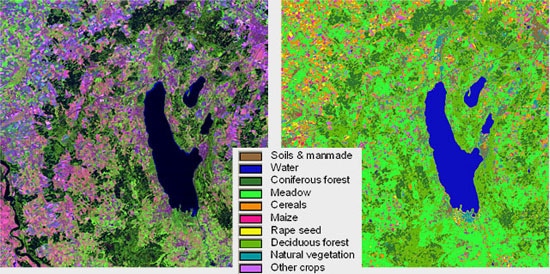
Fig. 2: Satellite image (false colors) with large-scale agricultural classification (spatial resolution 30×30 m)
Large-scale classification gives on overview over the structures of whole regions. Winter and summer crops can be separated with a very high accuracy. The derivation of crop cycles is also possible.
The assessment of the cultivated crops is based on time series and of satellite data, which have been precisely atmospherically corrected and were physical values (e.g. LAI) had been extracted. Using in- and after season classification methods, combing the knowledge on the physics of plant growth and AI methods, the information can be provided continuously refined within the season, or as final status.
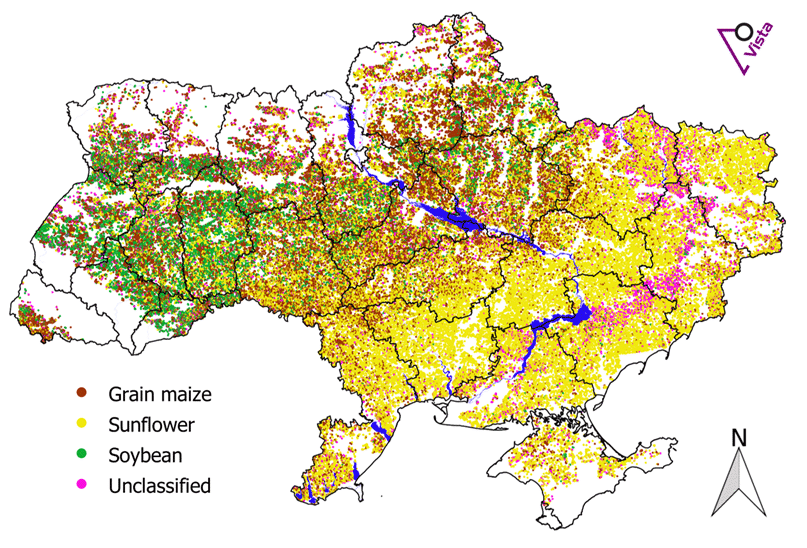
Continuous time series of satellite data, supported by plant growth simulation / modelling, allows the precisely determination of use of the land surface, the cultivation activities and crops types, even for very large regions. Stating from an initial differentiation of the crop types (winter or summer crops) a step-by-step refining of the monitoring can be performed, up to a specific distinction between the varieties the use of the arable land.
In-season generated distribution of the cultivation of selected crops in the Ukraine.
For the provision of aggregated products, representing the cultivation on larger areas (e.g. administrative areas), a sophisticated approach on representative sample observations enables effective monitoring.
Information provided is for example:
maps and/or numbers of total area of crops
split to different crops
distribution of crops
changes between the seasons
Focus areas of different cultivations, as well as zones of sparse agricultural activities due to natural or anthropologic impact can be identified.
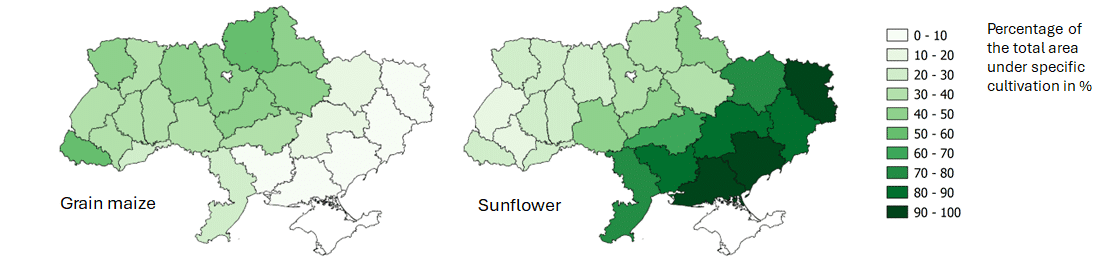
Regional aggregation of cultivation of maize and sunflower in the Ukraine.
Aggregated products (here: cultivation on oblast level in the Ukraine) allow to compare the situation with historic and/or statistical information.
Find out more about mapping of agricultural areas and crop classification at scale.